Why Two Identical Cars Never Have the Same Price
Inside our research on valuing a used car by its measured condition, forecasting time-to-sell and explaining every euro of a trade-in offer.
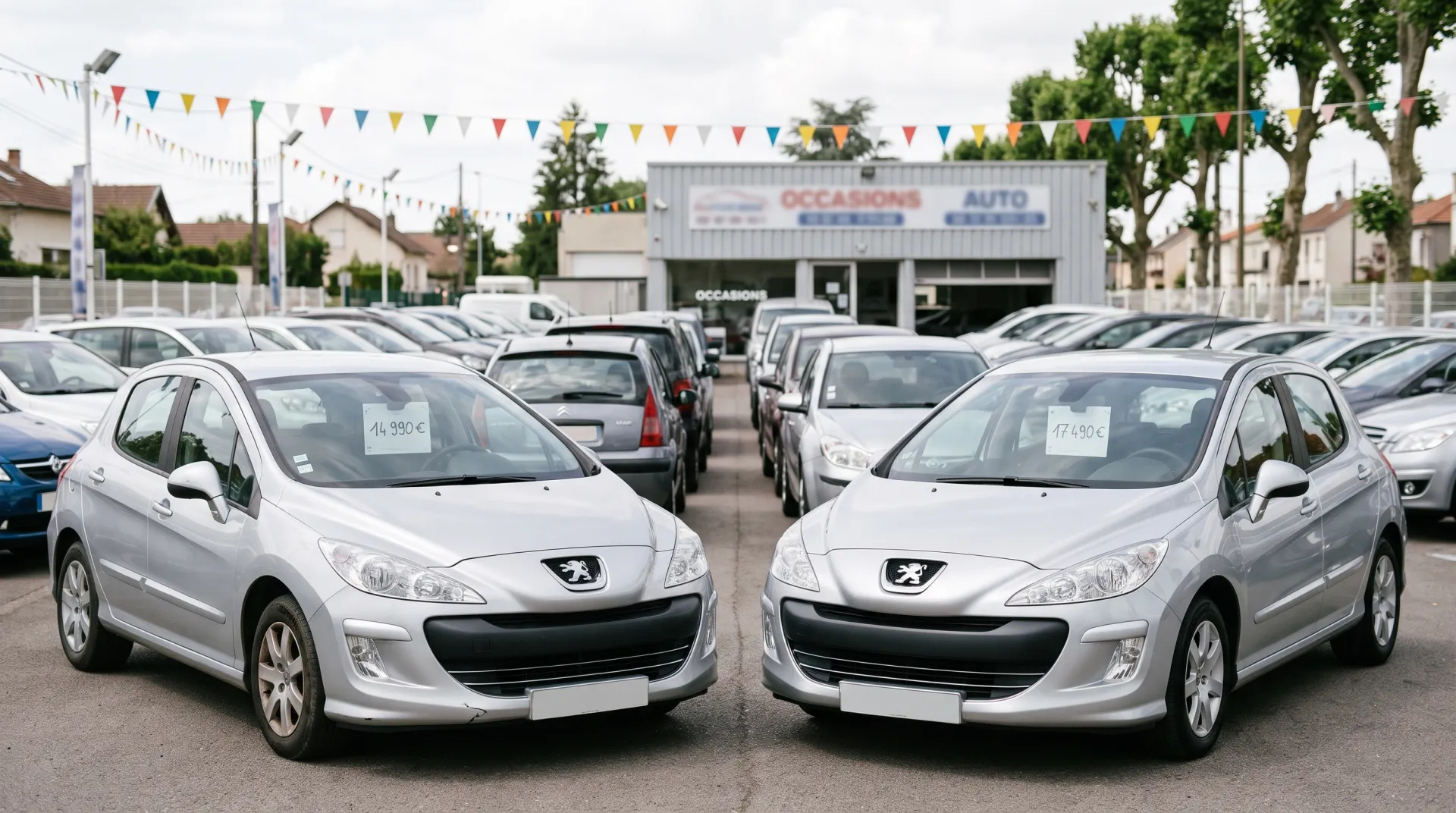
Picture two hatchbacks parked side by side on a dealer's forecourt. Same model, same year, same trim, 68,000 km on both odometers. Both are listed at €14,900.
The first has a healthy engine, a crisp clutch and a body without a mark. The second has a clutch close to the end of its life and a dented rear door that someone has tried to hide with a careful photo angle.
Look them up in any price guide and you get the same number for both. On paper they're the same car. On the road, in the workshop and in the buyer's mind, they're not.
That gap is what our research program on next-generation car pricing is about. We want to estimate the fair price of this particular car, not of a line in a catalogue.
Key takeaways
- Price guides value declared cars. We're researching how to value real ones, based on their measured condition.
- Asking prices aren't sale prices, and a listing that disappears isn't necessarily a sale.
- Price and time-to-sell are one decision, so we model them together.
- Honest uncertainty ranges beat false precision, especially for rare models and shifting markets.
- Every price should be explainable factor by factor, and the decision stays with the professional.
- This is ongoing R&D, with pilots targeted for 2028 (estimate).

The problem: guides price declarations, not cars
Most valuation tools start from what is declared: make, model, year, mileage, fuel type, options. Then they compare against asking prices seen on the market. Neither input tells you what condition the car is really in, or what it actually sold for.
For a dealer, that blind spot gets expensive fast. A trade-in mistake is paid twice: first in margin, when you pay too much for a car that needs work, and then in days in stock, when the car sits on the lot because it's priced above what the market will pay.
The time cost is real. A widely cited US industry benchmark puts the holding cost of a used vehicle at around $40 per day (NCM Associates, reported by CBT News) [5]. That's a US figure, and European costs are structured differently, but the principle is the same everywhere: every day a car sits unsold, its margin shrinks.
Declared attributes aren't always honest, either. The European Parliament estimated that odometer fraud affects 5–12% of domestic used-car sales and 30–50% of cross-border sales in the EU, costing between €5.6bn and €9.6bn a year [1]. If a price guide trusts the mileage it's given, it inherits the fraud.
The market itself is also moving. In France, used electric-vehicle transactions grew by 30% in 2025 (Avere-France / Mobilians) [4], in a segment where residual values have been volatile as new-EV prices, incentives and battery technology change. On top of that, the legislative rollback of low-emission zones (ZFE) in France in 2025–2026 shifts demand for some older vehicles that buyers had been avoiding.
"A trade-in mistake is paid twice: first in margin, then in days in stock."
What research and the market already do well
Let's be fair to existing work, because a lot of it is solid.
Machine-learning valuation models perform well on homogeneous, high-volume segments: popular compacts and mainstream SUVs, where thousands of comparable transactions exist. The auto-finance industry has invested heavily in trustworthy residual-value prediction, including for rare models; work from Hyundai Capital presented at AAAI 2023 is a good example [2]. Academic work on residual values in niche segments such as the luxury market keeps growing [3], and explainable pricing methods are getting better every year. Established players already give dealers valuations and stock-management tools that they use every day.
The limits are consistent across the field:
- Condition is collapsed into a single grade ("good", "average", "poor"), if it's captured at all.
- Asking prices and real transaction prices get mixed together.
- Time-to-sell is rarely predicted, even though it drives profitability.
- Uncertainty is rarely shown. You get one number, with nothing telling you how far off it could be.
The open scientific questions
This is the core of our program. None of these questions is fully solved, and each one is harder than it looks.
1. Putting a number on condition and isolating its effect
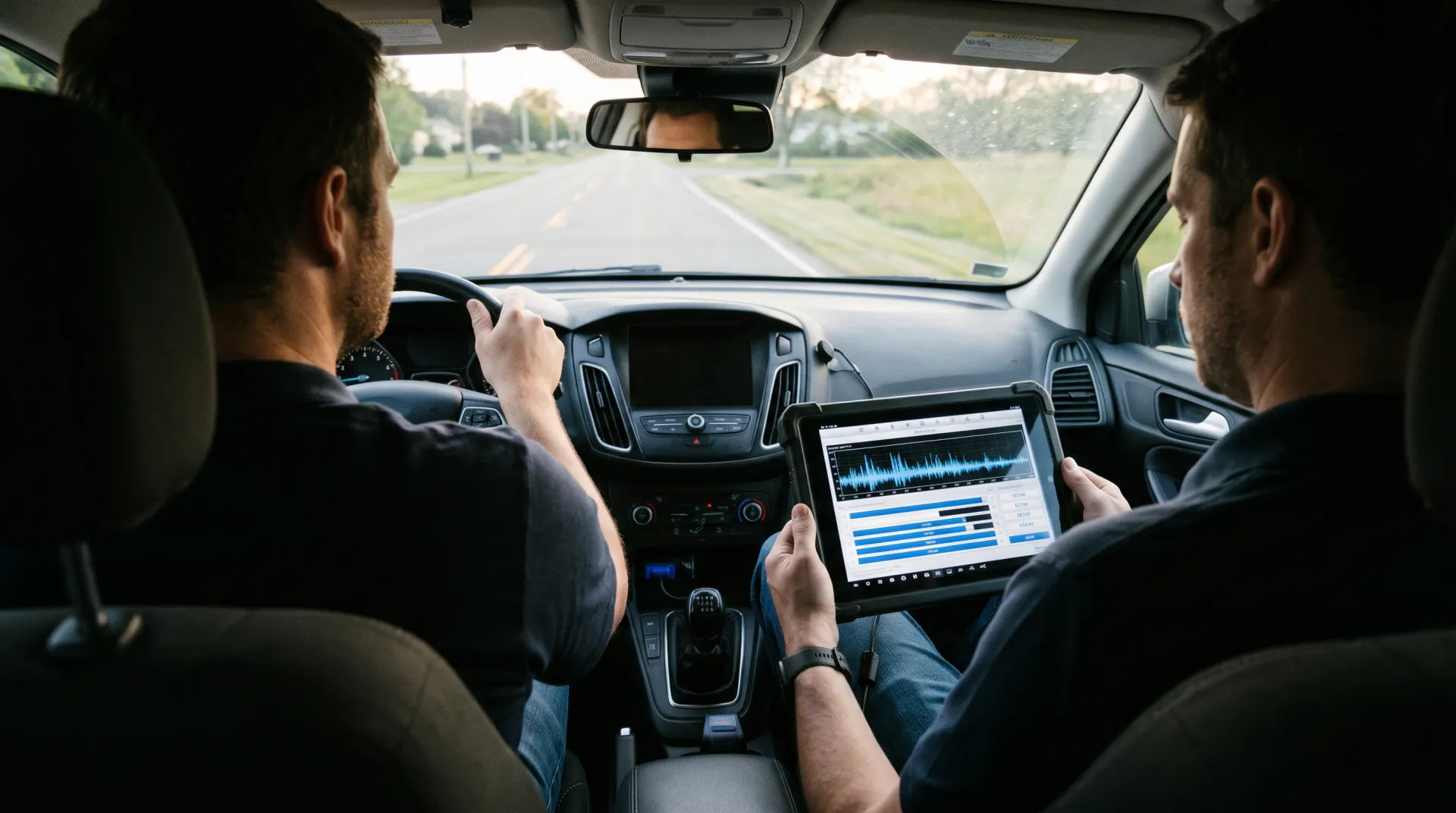
Our other research programs measure a car's real condition: body defects from imaging, and mechanical findings from inspection. The pricing question is: how many euros is a dented door worth? And a tired clutch?
The trap is confusing correlation with causation. Older, high-mileage cars tend to have more dents, so a naive model might "learn" that dents cost €2,000 when most of that is really the effect of age. Think of noticing that people who carry umbrellas get wet more often: the umbrella isn't what makes them wet. Separating the effect of condition from the effects of age and mileage is a real scientific problem, not just a data-plumbing task.
2. From asking price to real price
A listing that disappears isn't necessarily a sale. The car may have been sold, withdrawn, relisted elsewhere or taken in part-exchange. And when it was sold, the final price was often negotiated below what was asked. Learning the real transaction price from incomplete, noisy signals is one of the hardest parts of the problem.
3. Forecasting time-to-sell at a given price
Price and speed are two sides of the same decision. Lower the price by €500 and the car may sell three weeks sooner; raise it and you may wait two months. We want to model that trade-off between margin and stock turn explicitly, so a dealer can see both sides before choosing.
4. Rare models and thin markets
What's a fair price when there are only three comparable cars in all of Europe? Statistical models struggle when data is scarce. The research challenge is to borrow information from related models, trims and markets without pretending to know more than we do, and to widen the uncertainty range honestly when evidence is thin.
5. A moving market
EV price cuts, tax changes, local regulation, seasonal patterns: convertibles in spring, 4x4s before winter. A model trained on last year's market can be confidently wrong today. We're working on how to detect quickly when the market has shifted and adapt, rather than discovering it months later in aging stock.
6. Spotting outliers and fraud
Some listings shouldn't be trusted: mileage that goes backwards across a car's history, the same car listed several times with different details, "bait" prices designed to generate leads rather than sales. Flagging these protects buyers, and it also keeps bad data out of the valuation itself.
Our research direction
At a high level, here's where we're heading:
- Valuation grounded in measured condition, building on our body and mechanical inspection research, instead of a declared or guessed grade.
- Price ranges with explicit uncertainty instead of false precision: a narrow range when evidence is strong, a wider one when it isn't.
- Time-to-sell and trade-in offer in a single view, so the decision is made with both margin and stock turn in sight.
- Factor-by-factor explanations that a dealer can defend in front of a seller.
The trade-in offer itself follows a simple, transparent logic:
Optimal trade-in price
Trade-in offer = forecast resale price − reconditioning cost − holding cost − dealer's target margin
- Forecast resale price: what the car is expected to really sell for, given its measured condition.
- Reconditioning cost: what it will take to make it retail-ready.
- Holding cost: the cost of the expected days in stock.
- Target margin: set by the dealer, not by the model.
Each term carries its own uncertainty, and the research is about estimating each one well and combining them honestly.
One more point matters to us: choosing and validating data sources is itself part of the research. No source is considered reliable until we have validated it, and validation is ongoing work, not a one-off step.

Why explainability matters
A price nobody can explain is a price nobody trusts. When a dealer makes a trade-in offer, the seller usually has a number in mind, often from an online guide. A good conversation sounds like: "Your car is worth €X on the market today. We take off €Y for the clutch and €Z for the door, and it should take about four weeks to sell."
That's a price you can justify, not impose. It respects the seller, and it protects the dealer's credibility.
"A price nobody can explain is a price nobody trusts."
Explanations also keep the professional in control. Our outputs are decision aids: the final decision always stays with the dealer or garage, who knows their local market, their customers and their stock in ways no model will. Nothing here is financial advice.

Who benefits
- Dealers: better-calibrated trade-in offers, fewer cars bought too high, less aging stock.
- Garages: an objective value to support consignment sales on behalf of their customers.
- Buyers and sellers: a price that comes with an explanation, and suspicious listings flagged before anyone gets burned.
Closing
Back to the two hatchbacks on the forecourt. An experienced used-car manager would tell them apart in five minutes, by walking around them, listening to the engine and pressing the clutch. Our aim isn't to replace that judgment. It's to give it numbers, ranges and explanations that hold up in front of a seller, on every car.
If you run a dealership or a used-car operation and would like to help shape this research, or take part in our future pilots, get in touch with the Steer AI team. We'd be glad to hear from you.
References
- European Parliament, Resolution of 31 May 2018 with recommendations to the Commission on odometer manipulation in motor vehicles: revision of the EU legal framework (2017/2064(INL)). europarl.europa.eu
- Kim et al., "Trustworthy Residual Vehicle Value Prediction for Auto Finance," Proceedings of the AAAI Conference on Artificial Intelligence, 37, 2023. ojs.aaai.org
- "A Comprehensive Approach to Residual Value Analysis in the Luxury Automotive Market," IEEE Access, 2025. ieeexplore.ieee.org
- Avere-France & Mobilians, Baromètre des véhicules électriques d'occasion, Q4 2025. avere-france.org
- CBT News, coverage of used-vehicle holding costs (NCM Associates benchmark, about $40 per day, US figure). cbtnews.com