Listening to Cars: A Full Mechanical Inspection From One Test Drive
How a guided three-step test drive, combining sound and vibration with CAN data read through the OBD-II port, could become a shareable, explainable inspection report.
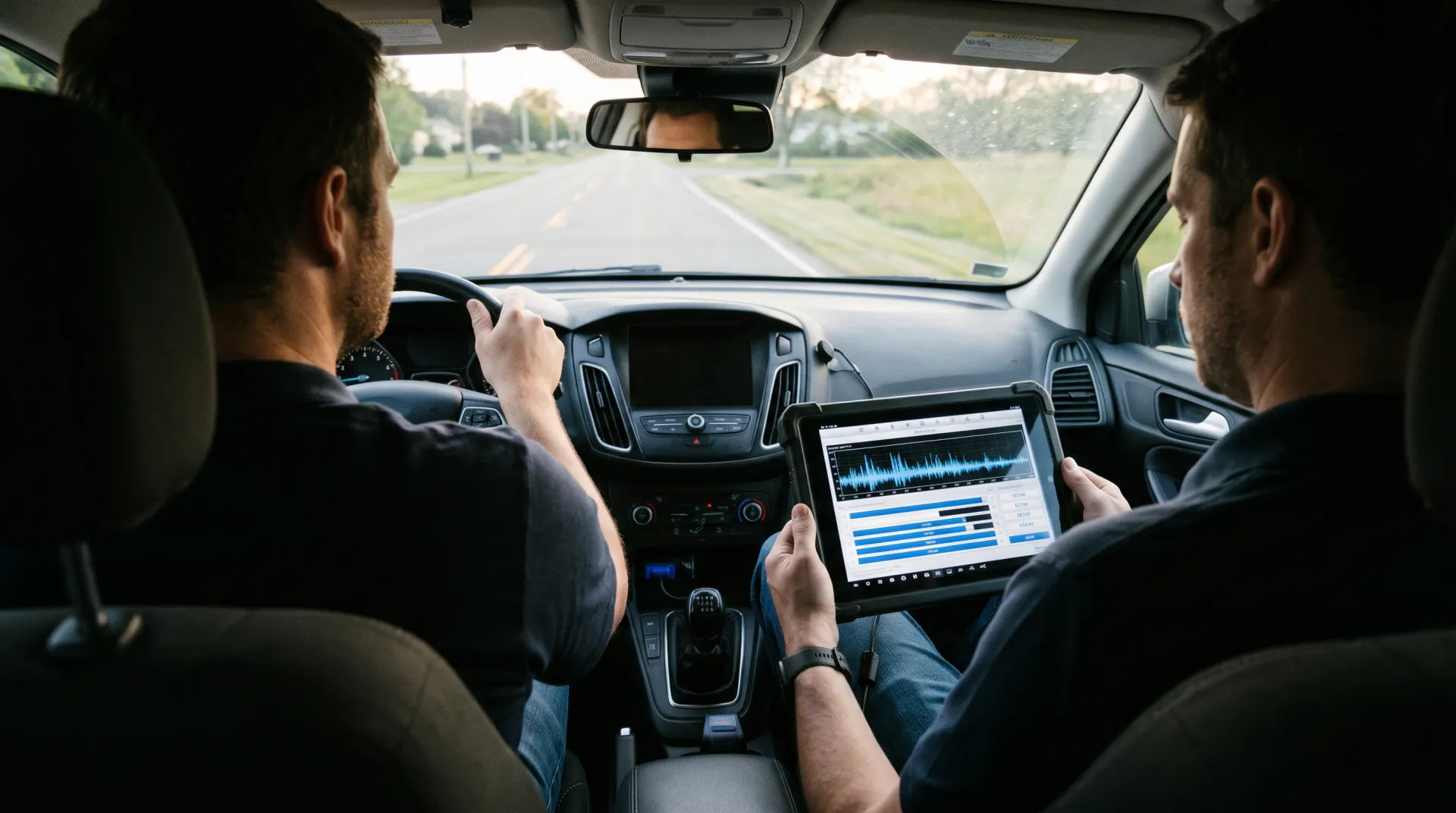
The car pulls out of the dealership lot. Marc, who has been a mechanic for twenty-six years, sits in the passenger seat. He says nothing during the first stretch of acceleration. At the roundabout he tilts his head slightly, and on the way back, as the car slows for the gate, he closes his eyes for a second.
"Front left bearing. And the auxiliary belt is starting to slip when it's cold."
He's right on both counts. There was no warning light on the dashboard and no fault code in the computer, and the car had a clean service record. His ears picked it up.
Every garage has a Marc, or wishes it did. That kind of listening is precious and rare, and it leaves no written trace. When Marc retires, it goes with him. Our research question is simple to state and hard to answer: can part of that expertise be captured, made explainable and shared, starting from one short test drive?
Key takeaways
- Fault codes only cover what a car's computers monitor. Many mechanical problems, such as a humming bearing, a squealing belt or a dragging brake, often produce no code at all.
- Our research program studies how a short, standardized test drive (acceleration → U-turn → braking) could support a full mechanical inspection by combining vehicle data, sound and vibration.
- The open questions are scientific: listening while driving, locating the source of a noise, coping with a very diverse car parc, and knowing when to say "please check this".
- The goal is to support the mechanic, not replace them. This is ongoing R&D, with pilots targeted for 2028 (estimate).
The blind spot of fault codes
Since the early 2000s, every car sold in Europe has had an OBD port, a socket under the dashboard that lets a reader collect fault codes from the vehicle's computers. It's a remarkable tool. But it has one structural limit: it only reports what the computers are designed to watch.
The engine control unit monitors combustion, emissions and dozens of sensors. Nobody asked it to listen to a wheel bearing. A worn belt, a loose heat shield, a tired shock absorber or a slightly dragging caliper can all go unreported, sometimes until the day they become a breakdown.
The figures suggest these gaps matter. In France, 19.44% of light-vehicle roadworthiness tests in 2024 required a re-inspection because of at least one major defect [3]. In Germany, the 12 V battery alone was responsible for 45.4% of the breakdowns ADAC attended in 2025 [4], a component that usually wears out gradually, long before it actually fails.
For a dealer taking in a trade-in, a fleet manager or a driver doing 40,000 km a year, the cost is the same: problems found too late, in the workshop or on the hard shoulder.

What research and industry already do
The idea of diagnosing a car by ear isn't new, and some very good work has already been published.
Researchers at the University at Buffalo, working with the online auction platform ACV Auctions, built a large-scale system that records the sound of an engine idling and revving on a stationary vehicle, then flags likely faults [1]. Deployed in a real marketplace, it was associated with a 20.85% reduction in post-sale arbitrations, meaning disputes between buyers and sellers after a sale. The same team later showed that combining sound with other vehicle signals helps pinpoint when a fault occurs within a recording [2].
That's a strong signal that listening works. But it was done with the car standing still, and many problems only appear when the car moves: under load, in a turn or while braking.
On the predictive maintenance side, most approaches rely on manufacturer telematics or large fleet databases. Those are powerful, but rarely available to an independent garage or a small dealership.
The regulatory landscape is shifting too. The EU Data Act, applicable since September 2025, gives users the right to access data generated by their connected products, including vehicles, and to share it with a third party of their choice, such as an independent repairer [5]. Access to vehicle data is becoming a matter of user choice, not just manufacturer permission.
Why the test drive matters
A mechanic never judges a car from the parking lot alone. They drive it, because each manoeuvre puts different parts under stress. Our standardized route follows the same logic in three short steps.
1. Acceleration. The engine, turbo, clutch and transmission are working under load. A knock, a ticking valve, a whistling turbo or a slipping clutch tends to show up here.
2. U-turn. At full lock and low speed, the steering, driveshafts and wheel bearings carry the strain. Clicking joints or a humming bearing often become audible.
3. Braking. The brakes, suspension and running gear take over. Grinding, squealing or a pull to one side are clues.
There's also a simple intuition behind the route, which experienced mechanics use without thinking about it. A noise that rises and falls with engine speed points to the engine side (belts, pulleys, valves, turbo). A noise that follows road speed points to the wheels side (bearings, tyres, brakes). Because the route makes engine speed and road speed vary in different ways, it helps separate the two families.

"A good mechanic doesn't just hear a noise. They hear when it happens, and that's half of the diagnosis."
The open scientific questions
This is the heart of the program. None of the questions below is solved, and each is an active research problem.
Listening while driving
A stationary engine in a quiet car park is one thing. A moving car is a noisy place, with tyres on asphalt, wind, the ventilation fan and the radio someone forgot to switch off. The mechanical noise we care about may be faint and short. Separating it from everything else, on any road and in any weather, is a hard problem.
Finding the source, not just a noise
Saying "something is wrong" isn't very useful to a mechanic. The value lies in where and what: front or rear, left or right, engine or wheel, bearing or brake. Sound travels through the whole body of the car, so a noise heard in the cabin doesn't necessarily come from where it seems to.
The diversity of the car parc
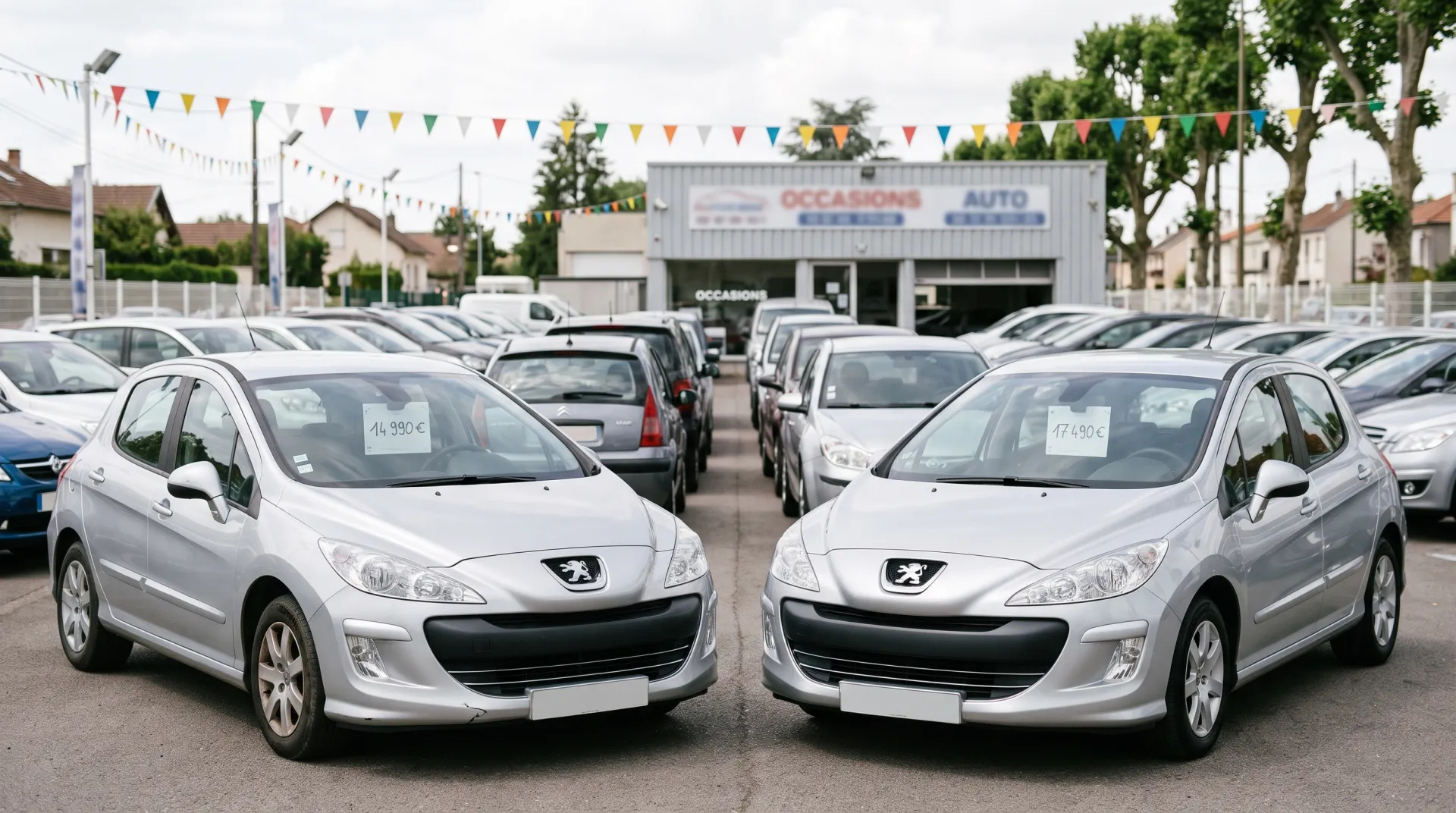
Europe's roads carry thousands of engine and model combinations, each with its own "normal" sound. A healthy diesel can sound alarming next to a petrol hybrid. Many faults are rare, and examples labelled by experts are scarce, because every label takes a skilled person's time and judgment.
Knowing when to say "please check this"
The costs of errors aren't symmetrical. A false "all clear" on a failing brake is far worse than a cautious "to check" on a healthy one. So the system has to measure its own confidence, and say so honestly when it isn't sure, instead of always giving a confident-looking answer.
Anticipating wear from partial data
For drivers who cover long distances, the question is "how long before this part fails?" rather than "is something wrong today?". Answering it means estimating the remaining life of batteries, brakes, clutches, turbos or injectors from incomplete information, on a small, low-power device, while respecting privacy and keeping as much processing as possible close to the car.
Our research direction
Without going into methods, here are the principles guiding our work:
- Diagnosis while driving, with accessible hardware. No test bench, no lift and no privileged access to manufacturer systems. The aim is something a garage or a dealership could realistically use on any car.
- Vehicle CAN data, read through the OBD-II port. Beyond fault codes, we use the signals travelling on the CAN bus (engine speed, vehicle speed, throttle position, braking…), available through the OBD-II port found on every modern car. They let us tie each sound and vibration to what the car is doing at that moment.
- Source localization a mechanic can understand. Each finding should come with an explanation in the mechanic's own terms: which step of the route revealed it, and whether it follows engine speed or road speed.
- A clear, honest report. Each component is classified as Finding, To check or OK, with a confidence level.

Above all, the mechanic stays in charge. The report is a pre-diagnosis that points to where to look first and keeps a record of what was heard. The expert confirms, decides and repairs.
What it could change
For dealers, a more objective trade-in evaluation, fewer surprises once the car reaches the workshop, and a shareable report that builds trust with buyers.
For garages, a pre-diagnosis that guides the job before the car even reaches the lift, so less time goes into searching and more into fixing.
For drivers, especially long-distance drivers, an optional connected device could give alerts before a breakdown and support servicing based on actual wear rather than fixed mileage. Brake pads that still have plenty of life wouldn't be changed early, and a weakening battery wouldn't be left until it leaves you stranded.
Throughout, data is only collected with the driver's explicit consent, in line with the GDPR.
Closing
Back to Marc in the passenger seat. His ears are the product of a quarter-century of listening, and no system will match that overnight. What we can try to do is make that kind of listening a little less rare, put it on paper and make it available on every car that goes through a dealership or a garage.
If you run a garage, a dealership or a fleet and would like to help shape this research, or take part in our future pilots, get in touch with the Steer AI team. We'd be glad to hear from you, and even more glad to listen to your cars.
References
- D. Fedorishin, J. Birgiolas, D. D. Mohan, L. Forte, P. Schneider, S. Setlur, V. Govindaraju, "Large-Scale Acoustic Automobile Fault Detection: Diagnosing Engines Through Sound," Proceedings of the 28th ACM SIGKDD Conference on Knowledge Discovery and Data Mining (KDD), 2022. doi.org/10.1145/3534678.3539066
- D. Fedorishin et al., "Fine-Grained Engine Fault Sound Event Detection Using Multimodal Signals," IEEE International Conference on Acoustics, Speech and Signal Processing (ICASSP), 2024. ieeexplore.ieee.org
- UTAC-OTC, Bilan annuel du contrôle technique des véhicules légers 2024. utac-otc.com
- ADAC, ADAC-Pannenstatistik 2025. adac.de/rund-ums-fahrzeug/unfall-schaden-panne/adac-pannenstatistik
- Regulation (EU) 2023/2854 of the European Parliament and of the Council of 13 December 2023 on harmonised rules on fair access to and use of data (Data Act). eur-lex.europa.eu/eli/reg/2023/2854/oj